Further details on ECM Part 3
Part 3 of the ECM Standard defines the DuplicateIsrcClusterNotification and DuplicateIsrcClusterRequest messages.
The DucplicateIscrcClusterNotifiction (see here) may serve as both the initial message and the response to a DuplicateIsrcClusterRequest, ensuring a consistent and complete representation of the cluster at the time of exchange.
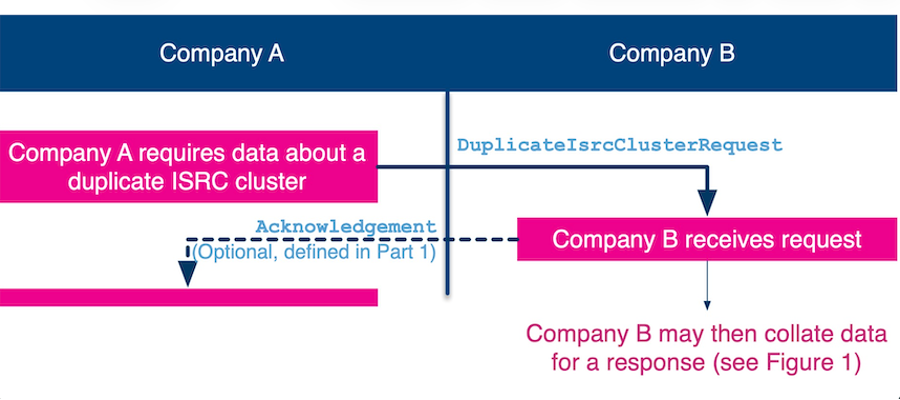
The DuplicateIsrcClusterRequest (see here) can be used to explicitly request the recipient to send a DucplicateIscrcClusterNotifiction at any time. This functionality is particularly useful in scenarios where:
An update to a previously exchanged cluster is required (e.g., for internal analysis or reconciliation purposes); or
The requester has no information about members of the cluster for which data is requested.
The DuplicateIsrcClusterRequest enables a recipient to request clusters based on an ISRC. Use of this message to start a communication is optional.
In most cases, the transmission of a DucplicateIscrcClusterNotifiction implicitly serves as a request for a response (unless the DucplicateIscrcClusterNotifiction is sent in response to an earlier DucplicateIscrcClusterNotifiction, eliminating the need for a separate DuplicateIsrcClusterRequest.
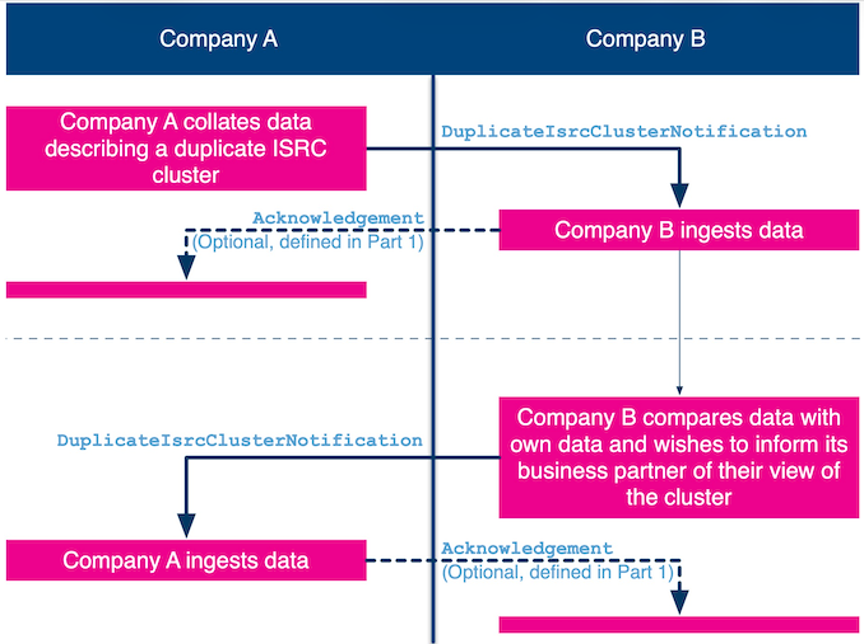
The clusters exchanged in a DucplicateIscrcClusterNotifiction message between business partners represent a statement of truth, as determined by the message sender, at a specific point in time. Verification of the accuracy, completeness, or legitimacy of the cluster information is outside the scope of this standard and must be addressed through separate governance, contractual, or operational processes.
Messages exchanged under this specification are communicated bilaterally between a sender and a recipient and are explicitly stateless in nature reflecting the sender’s best knowledge based on the most recent data sets available at that time. Such messages do not assert ongoing correctness, completeness, or authoritative status beyond the point of exchange.
In some cases, there may be valid commercial, financial, or operational reasons why identical sound recordings have been assigned different ISRCs. Only the rights holder is in a position to distinguish between cases where different ISRCs have been allocated as they are associated with distinct royalty obligations and those that are duplicates that have been assigned in error.
Therefore, the notification of a cluster with ISRC for the same resource does not indicate automatically that the recipient should update, revoke or replace their own duplicate ISRC cluster.
The DuplicateIsrcClusterNotification message does, however, provide data points that allow the sender to indicate whether the cluster was created by a rights holder, an MRT company, or another stakeholder. This contextual information, combined with elements such as MembershipType AVS, LinkVerification AVS, and the Confidence score, enables the recipient to make an informed decision. The recipient may then choose to return a corresponding DuplicateIsrcClusterNotification to communicate a duplicate ISRC cluster for the same sound recording in response.
MembershipTypeindicates whether the cluster was created using an audio reference file, reference metadata, or both.LinkVerification describes the checks and validations performed to determine the inclusion of a resource as a
ClusterMemberwithin a cluster; andConfidence expresses the level of certainty associated with the inclusion of a resource as a ClusterMember.